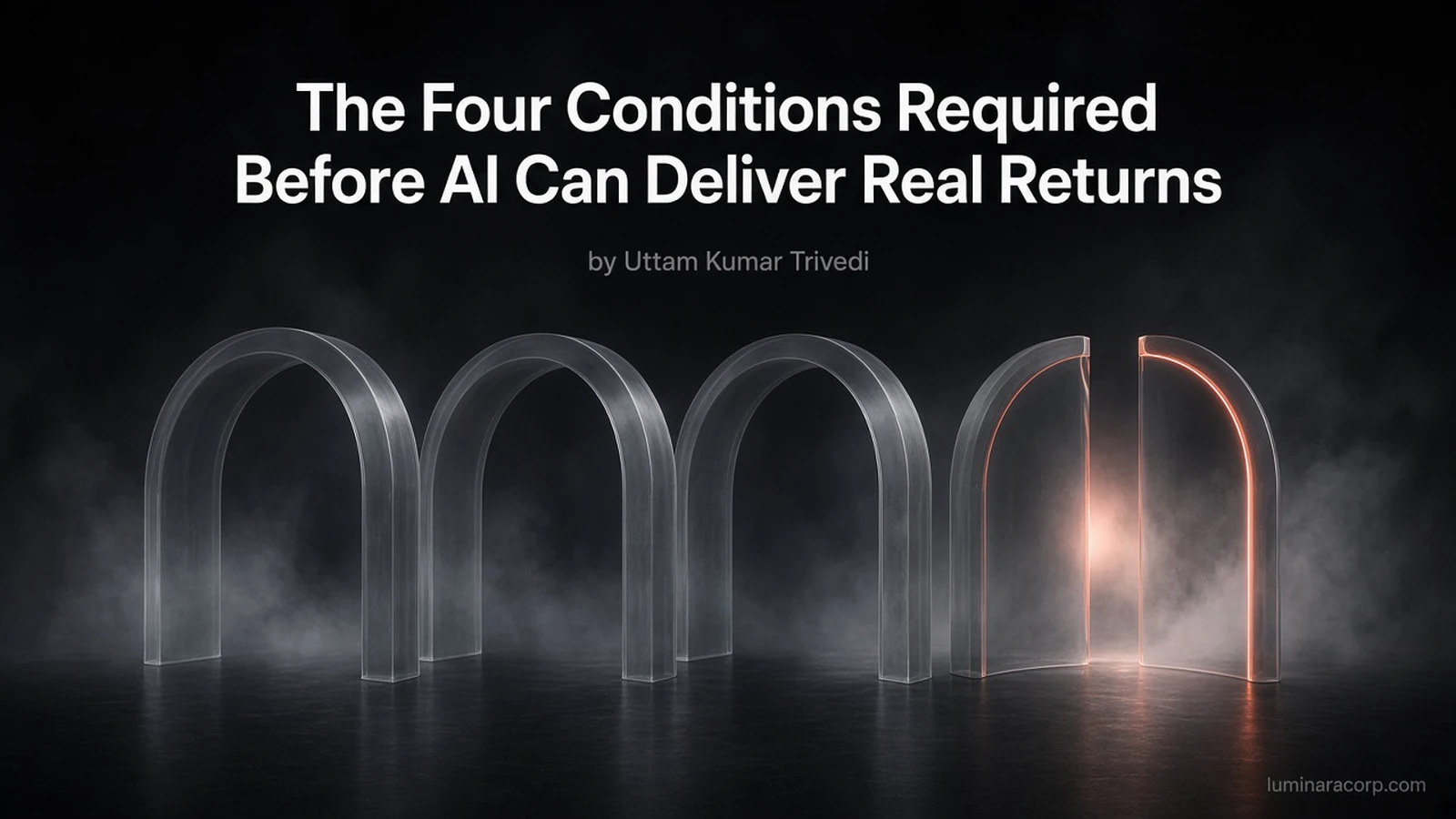
Most enterprises are discovering that simply deploying AI does not automatically create value. The technology can be powerful, the models accurate, and the investment significant — yet the expected returns remain elusive. The missing piece is not more technology. It is the presence of four specific conditions that must exist before AI can move from activity to actual business impact.
These conditions are rarely discussed in AI strategy presentations because they are not technical. They are organizational. Without them, even the best models will underperform or remain stuck in pilot mode. With them, AI has a genuine chance to deliver measurable, sustained returns.
Condition 1: Clear Ownership of Outcomes
Someone must own the business result, not just the model. When AI initiatives are owned only by data science or IT teams, the link between technical performance and business performance stays weak. Real returns require a business owner who is measured on the outcome the AI is supposed to improve — whether that is cost reduction, revenue growth, or risk mitigation.
Condition 2: Decision Rights Aligned with AI Outputs
AI can generate recommendations or predictions, but it only creates value when those outputs actually influence decisions. If the people who receive AI insights do not have the authority to act on them, or if existing processes override the recommendations, the system produces noise rather than impact. Decision rights must be explicitly updated alongside the technology.
Condition 3: Data and Process Readiness at the Point of Use
Many organizations invest in advanced models while the day-to-day data and workflows that feed and use those models remain fragmented or manual. AI performs best when the surrounding processes are already reasonably disciplined. Without this foundation, the model quickly becomes another system that requires constant human correction.
Condition 4: Sustained Measurement Tied to Business KPIs
Most AI projects are measured on technical metrics during the pilot phase. Once deployed, measurement often fades. Real returns require ongoing tracking against the same business KPIs that justified the investment in the first place. Without this discipline, it becomes impossible to know whether the AI is actually delivering or quietly drifting into irrelevance.
These four conditions are not exciting. They are operational. Yet they determine whether AI becomes a source of real competitive advantage or simply another expensive initiative that leadership eventually stops asking about.
This manufacturer boardroom scene is an illustrative composite, not a named client. A global manufacturer spent eighteen months and several million dollars on an AI initiative. The project delivered impressive dashboards, strong model accuracy in testing, and enthusiastic internal presentations. At the end of the year, the CFO asked a simple question: “Where is the actual improvement in our P&L?” The room went quiet. No one had a clear answer.
| What Companies Focus On | What Actually Drives Returns |
|---|---|
| Model accuracy and technical performance | Whether the output changes real decisions and workflows |
| Speed of deployment | Whether the operating model can absorb and sustain the change |
| Number of use cases launched | Whether each use case is tied to a measurable business KPI |
| Building internal AI teams | Whether those teams have authority and incentives aligned with outcomes |
- Success is measured by model performance instead of business performance.
- AI initiatives are launched without changing the decision rights or incentives of the teams that must use them.
- Governance and data quality are treated as afterthoughts rather than prerequisites.
- The organization celebrates deployment instead of sustained usage and measurable outcomes.
- Leadership continues to ask “What AI are we doing?” instead of “What has actually improved because of AI?”
We built the AI. We just never built the organization that could actually use it.
Limitations and corrections
The four conditions are an operating frame from practice, not a statistical model of returns. The manufacturer boardroom scene, including time and spend figures, is an illustrative composite. It is not a named client case and does not quantify industry-wide returns.
To request a correction, contact Luminaracorp.